Modified on 06/11/2026 by AxiaFunder Team
Investor Guide to Litigation Funding

PART I
INVEST IN LITIGATION FUNDING
1. Introduction to litigation funding
1.1 What is Litigation Funding?
Litigation funding, also known as third-party funding or litigation finance, involves financing legal claims by third parties in exchange for an agreed share of the proceeds. Litigation funding therefore provides investors with access to an alternative asset class with its own distinct risk and return characteristics.Litigation funders can provide funding to parties directly or indirectly involved in legal proceedings, depending on the structure of the funding arrangements.
1.2. Benefits of Litigation Funding
Litigation funding offers a range of potential benefits to claimants, law firms and investors. For investors, it provides access to an alternative asset class with the potential to generate attractive returns and diversify their investment portfolios.For claimants, litigation funding helps level the legal playing field by covering costs such as solicitors’ and barristers’ fees, expert witness fees, court fees and other litigation-related expenses. This enables individuals and businesses with meritorious claims to pursue legal action that might otherwise be financially prohibitive.
For law firms, litigation funding provides the financial resources to pursue cases that might otherwise not be viable, expand their client base and manage cash flow more effectively. It can also reduce the financial risks associated with funding litigation, particularly where firms operate on a contingent fee basis, by providing capital to cover operating expenses and support portfolios of claims.
2. Litigation Funding as an Investment
Litigation funding is an alternative asset class that offers the potential for attractive financial returns, portfolio diversification and broader social impact. Its key characteristics are outlined below.2.1. Potentially Attractive Returns
Portfolio litigation funding typically targets annualised returns in excess of 20%, offering greater diversification across multiple claims and a potentially lower risk profile.In contrast, funding individual high-value claims typically targets annualised returns of 25–35% or more, reflecting the higher risks associated with investing in such claims. Targeted returns are not guaranteed, and capital remains at risk.
2.2. Non-Correlation
The performance of litigation funding investments is primarily driven by the progress and outcomes of legal claims rather than fluctuations in the broader economy or financial markets.As a result, returns from litigation funding are largely independent of the economic cycle, offering non-correlation with traditional asset classes such as equities, bonds and real estate, and providing meaningful diversification benefits to investors
2.3. Diversification
Investors can achieve further diversification by spreading their capital across multiple litigation investments rather than concentrating it in a single claim. This reduces exposure to the outcome of any individual claim and, where investments involve different law firms and types of litigation, can also reduce concentration risk.However, the extent of diversification depends on the characteristics of the underlying claims, and diversification does not eliminate the possibility of investment losses.
2.4. Levelling the Playing Field for Justice
Litigation funding can help improve access to justice by enabling individuals and small and medium-sized enterprises (SMEs) to pursue meritorious claims against better-resourced opponents.By reducing the financial barriers associated with litigation, funding can help ensure that the ability to pursue legal action is not determined solely by a claimant's financial resources.
3. Litigation Funding Risks
3.1. Losing a Case
Litigation funding is typically provided on a non-recourse basis, meaning that the funded party is generally not required to repay the funding if the claim is unsuccessful. As a result, investors may lose some or all of their invested capital.Many legal claims are resolved through settlement before reaching trial. Even where a case does not progress as anticipated, the parties may still reach a settlement, potentially allowing investors to recover some or all of their capital and receive a lower-than-expected return. However, in some instances, investors may recover only part of their capital or suffer a complete loss.
3.2. Adverse Costs
In England and Wales, the unsuccessful party in litigation may be required to pay some or all of the successful party's legal costs, commonly referred to as adverse costs. Depending on the circumstances and the funding arrangements, a litigation funder may also be exposed to adverse costs liability, potentially resulting in additional financial losses.3.3 Operational Risk
Where litigation funding is provided directly to law firms, investors are exposed to risks associated with the funded firm's financial stability and operational performance. Poor financial management, operational difficulties or insolvency could disrupt the progress of funded claims, resulting in delays, additional costs, reduced returns or capital losses.While AxiaFunder's funding agreements generally allow for another law firm to take over the conduct of funded claims, there is no guarantee that all claims can be successfully continued.
4. Mitigating investment risks in litigation funding
4.1. Law Firm Assessment and Monitoring
When providing funding to law firms, litigation funders can mitigate operational risks by conducting thorough due diligence on prospective law firm partners and monitoring their financial and operational performance. For portfolio funding, reviewing the underlying claims and monitoring their progress can further help identify and address potential risks.4.2. Rigorous Claim Assessment
Litigation is inherently unpredictable and even claims with strong legal merits may ultimately be unsuccessful. Rigorous case assessment and selection can help mitigate this risk by identifying claims with strong legal merits and favourable prospects of success. This involves evaluating the legal merits, prospects of success and other relevant risk factors before funding is committed.4.3. Diversification Across Multiple Investments
Diversification is an important risk mitigation strategy in litigation funding. By spreading capital across multiple investment opportunities, investors can reduce their exposure to the performance of any single claim, portfolio or law firm.However, diversification does not eliminate the risk of investment losses, particularly where claims share common legal or operational risks.
4.4. After the Event (ATE) Insurance Cover
After the Event (ATE) insurance helps mitigate adverse costs risk by covering certain legal costs that a claimant may be required to pay to the opposing party if a claim is unsuccessful, subject to the terms and limits of the policy.Litigation funders may require ATE insurance to be in place before legal proceedings are issued as part of their risk mitigation strategy.
4.5. Other Risk Mitigation Strategies
Litigation funders can further mitigate investment risks by negotiating favourable contractual terms with funded parties. These may include provisions governing the priority of payments from litigation proceeds, repayment arrangements, fee structures, terms governing early settlement, and rights in the event of adverse developments.Such contractual protections can help safeguard investors' interests, although their effectiveness depends on the circumstances of each investment and the enforceability of the relevant agreements.
5. Types of litigation funding
5.1. Law Firm Funding[XL1] [CL2]
Litigation funding can be provided directly to law firms to support their operating expenses and cash flow requirements. Such funding is typically supported by the anticipated revenue from a portfolio of cases handled by the firm on a full or partial contingency fee basis.Funding supported by a portfolio of claims can provide greater diversification than funding an individual case, although investors remain exposed to the financial and operational performance of the law firm.
One important risk to consider is that law firms do not own their clients' claims. Claimants may change legal representation, potentially affecting the law firm's anticipated revenue and its ability to repay the funding[1]. Furthermore, the law firm owes professional duties to its clients rather than the funder, which must be considered when structuring funding arrangements.
The advantage of funding a law firm secured on the revenue from a portfolio of claims, rather than the claimants directly is that the law firm is generally required to replace any claims that have failed with new claims that meet the agreed criteria. This makes it more likely that investors will be paid their targeted return provided the law firm continues to trade.
5.2. Claimant Funding
Claimant funding is a common form of litigation funding in which a third-party funder provides capital directly to a claimant to cover some or all of their legal costs in exchange for an agreed share of the proceeds from a successful settlement or judgment.Funding is typically provided on a non-recourse basis, meaning that the claimant is generally not required to repay the funding if the claim is unsuccessful. This allows claimants to pursue litigation while reducing their upfront financial burden and exposure to litigation costs.
Returns to funders are generally linked to the amount recovered and may increase depending on the duration of the proceedings and the terms of the funding agreement.
A key risk associated with funding an individual claim is the concentration of capital in a single case. If the claim is unsuccessful, the funder may lose some or all of its investment.
5.3. Bankruptcy Funding
Litigation funding can also be used in bankruptcy and insolvency proceedings to finance legal claims pursued by debtors, insolvency practitioners, trustees or creditors.Such funding can enable claims to proceed where the insolvent estate lacks sufficient resources to cover litigation costs, potentially increasing recoveries available to creditors.
Depending on the jurisdiction and the circumstances of the proceedings, court approval may be required for certain funding arrangements. The funder's rights and involvement in the litigation are governed by the applicable legal framework and funding agreement, while legal representatives remain subject to their professional duties to their clients.
6. What can litigation funding be used for?
Litigation funding can be used to cover a range of legal costs and other expenses associated with pursuing a claim, as well as certain working capital requirements.The scope and terms of funding vary depending on the stage of litigation, the risks involved and the anticipated recovery from a successful settlement or judgment.
6.1. Pre-Settlement Stage
Pre-settlement funding provides capital before a claim has been resolved. It can be used to cover litigation-related expenses, including solicitors' and barristers' fees, expert witness fees, court costs and After the Event (ATE) insurance premiums.In some cases, funding may also be used to support a business's working capital requirements during lengthy legal proceedings, particularly where traditional financing sources are unavailable or insufficient.
6.2. Post-Settlement Stage
Post-settlement and post-judgment funding provides capital after a settlement has been reached or a judgment obtained, but before the proceeds have been received.There may be a significant delay between the resolution of a claim and receipt of payment. Such funding can help claimants access a portion of their anticipated proceeds earlier, providing liquidity while they await payment.
PART II
INVEST WITH AXIAFUNDER
7. AxiaFunder
7.1. About Us
AxiaFunder is an online litigation funding platform that connects investors with carefully selected litigation investment opportunities offering the potential to generate attractive risk-adjusted returns. We focus on the smaller end of the litigation funding market, primarily in the UK and continental Europe, where we believe there is a significant shortage of available capital and a substantial number of commercially viable claims. AxiaFunder’s investments primarily focus on providing portfolio funding via law firms, financing the disbursements and costs required to progress portfolios of legal claims, as well as funding individual high-value commercial litigation cases.AxiaFunder was among the first litigation investment companies in the UK and the first online litigation funding platform in Europe. AxiaFunder is a trading name of Champerty Limited (FRN 968527), which is authorised and regulated by the Financial Conduct Authority (FCA).
Our team brings over 40 years of combined financial experience and over 30 years of combined litigation experience, underpinning our rigorous due diligence process, investment structuring, and ongoing case monitoring. As of October 2026, AxiaFunder has deployed over £35 million across a diverse range of case types, including housing disrepair, shareholder disputes, and group actions. Of this total, approximately £30 million has been deployed to support more than 11,000 portfolio claims, with over 4,000 claims already successfully resolved. For full historical performance details, please visit our Track Record page.
Unlike traditional litigation funds, where investors typically commit capital to a pooled fund, AxiaFunder allows investors to select individual investment opportunities and build their own portfolios. This gives investors greater control over their investment decisions and allows them to deploy capital selectively, potentially reducing cash drag associated with traditional fund structures.
Investments are structured through Scottish Limited Partnerships, which may offer tax advantages to investors. We also place a strong emphasis on transparency and communication, providing quarterly investment updates and access to a secondary market, offering investors the opportunity to exit their investments before resolution, subject to buyer demand.
7.2. Portfolio Offers
7.2.1. Introduction
Portfolio offers allow investors to invest in a large number of relatively low-value claims that are litigated separately and may have different outcomes, providing greater diversification and reducing exposure to any single claim.These portfolios may include housing disrepair (HDR), undisclosed commission, diesel emissions and other types of consumer claims. Each investor gains an equal proportionate exposure to every claim funded within the portfolio. For detailed performance data across our portfolio investments, review our analysis on AxiaFunder portfolio investment returns.
Portfolio claims may have shorter durations, with resolutions for some case types such as HDR generally expected within 18 months. Distributions are generally made progressively as claims settle, once the repaid principal reaches specified thresholds, typically in increments of 10% of the original invested amount. Compared with investments in individual commercial litigation cases, portfolio offers generally have a lower risk-return profile, reflecting the diversification across a larger number of independent claims.
One of the main risks associated with portfolio offers is the operational risk of the law firm managing the claims. Poor case management, financial difficulties or insolvency of the law firm could delay claim resolutions, increase costs or potentially result in a partial or total loss of invested capital. AxiaFunder seeks to minimise these issues by due diligence prior to funding and active communication with funded law firms until the claims have resolved and the AxiaFunder’s investors have been repaid.
7.2.2. Due Diligence Process
Before providing funding to a law firm, AxiaFunder conducts a comprehensive due diligence assessment covering the firm's financial stability, operational capabilities, track record and the experience and expertise of its legal team.As part of this process, we review a range of supporting documentation, including financial statements, sample claim documents, key personnel CVs and other relevant operational and financial information. We also conduct a series of interviews and discussions with key personnel to assess the firm's management, internal processes and ability to manage the funded portfolio effectively. Where appropriate, we consult industry experts and seek references from industry professionals to gain further insight into the firm's reputation, capabilities and associated risks.
In addition, we assess the nature and quality of the underlying claims, including their prospects of success. Alongside our general claim assessment criteria (see Section 7.3.2.), we apply additional criteria specific to each type of portfolio claim. For example, when assessing housing disrepair claims, we consider whether there is actionable disrepair, evidence of a complaint made to the landlord and whether the claim meets a minimum value threshold of £1,000.
7.2.3. Monitoring[2]
Following investment, AxiaFunder closely monitors the financial and operational performance of funded law firms through regular reviews of management accounts, cash flow statements and bank statements, periodic audits and in-person visits. We also hold weekly meetings with key personnel and maintain ongoing communication via phone and email to discuss operational performance, case progress and any emerging issues.In addition to monitoring the law firms themselves, regarding HDR funding, we regularly review the progress of the underlying claims. This includes reviewing claim-level information provided by the firms, tracking key litigation milestones and identifying any claims that may no longer meet the required criteria or are underperforming.
Where potential issues are identified, we engage with the relevant law firm to address them and, where appropriate, may request the replacement of claims, subject to the terms of the funding agreement.
Investors receive quarterly portfolio updates summarising the progress of their investment, including the number of claims issued, claims requiring replacement, claims for which surveyors have been instructed and other key developments.
7.2.4. Resolution
The investments are structured as Scottish Limited Partnerships (SLPs). As claims resolve, principal and agreed returns are paid into the Partnership. Once accumulated proceeds reach 10% of total invested capital—and at each subsequent 10% increment—the Partnership distributes the capital and corresponding returns (net of applicable fees and expenses) to investors via the redemption of partnership interests.For example, assuming an offer funds a portfolio of 100 equally funded claims and the full principal is recovered on each claim, every 10 resolved claims would trigger the redemption of 10% of investors' original Partnership interests and the distribution of the corresponding principal and returns. Investors will receive a detailed resolution update and be notified of the distribution by email.
7.3. Commercial Claim Offers
7.3.1. Introduction
Single commercial claim offers allow investors to invest in individual high-value commercial litigation claims and build their own portfolio by investing across multiple cases. Commercial litigation covers a broad range of business-related disputes involving companies, individuals or both. Commonly funded claims include shareholder and partnership disputes, breaches of contract, commercial fraud and intellectual property disputes.To examine anonymised histories and outcomes of past claims, explore our published Case Studies.These claims typically have longer durations, with resolutions generally expected within three years, although some may take longer. Most claims are expected to settle before trial. Compared with portfolio offers, single commercial case investments generally have a higher risk-return profile, as the investment outcome depends on the success of an individual claim.
The main risk associated with single commercial claim offers is losing the underlying case, resulting in a total loss of capital and potential adverse cost liabilities (see Section 3.2: Adverse Costs and Section 4.4: After-the-Event (ATE) Insurance for details on how these exposures are managed).
7.3.2. Due Diligence Process
Commercial litigation claims are sourced through various channels, including litigation brokers, insolvency practitioners, claimants and law firms directly.Before approving a claim for funding, AxiaFunder conducts a comprehensive due diligence assessment, generally targeting a probability of success at trial of at least 65%. The vast majority of claims settle pre-trial and therefore the probability of a positive resolution is typically higher that the probability of winning at trial — however the realised settlement amount may be lower than the expected quantum achievable at trial.
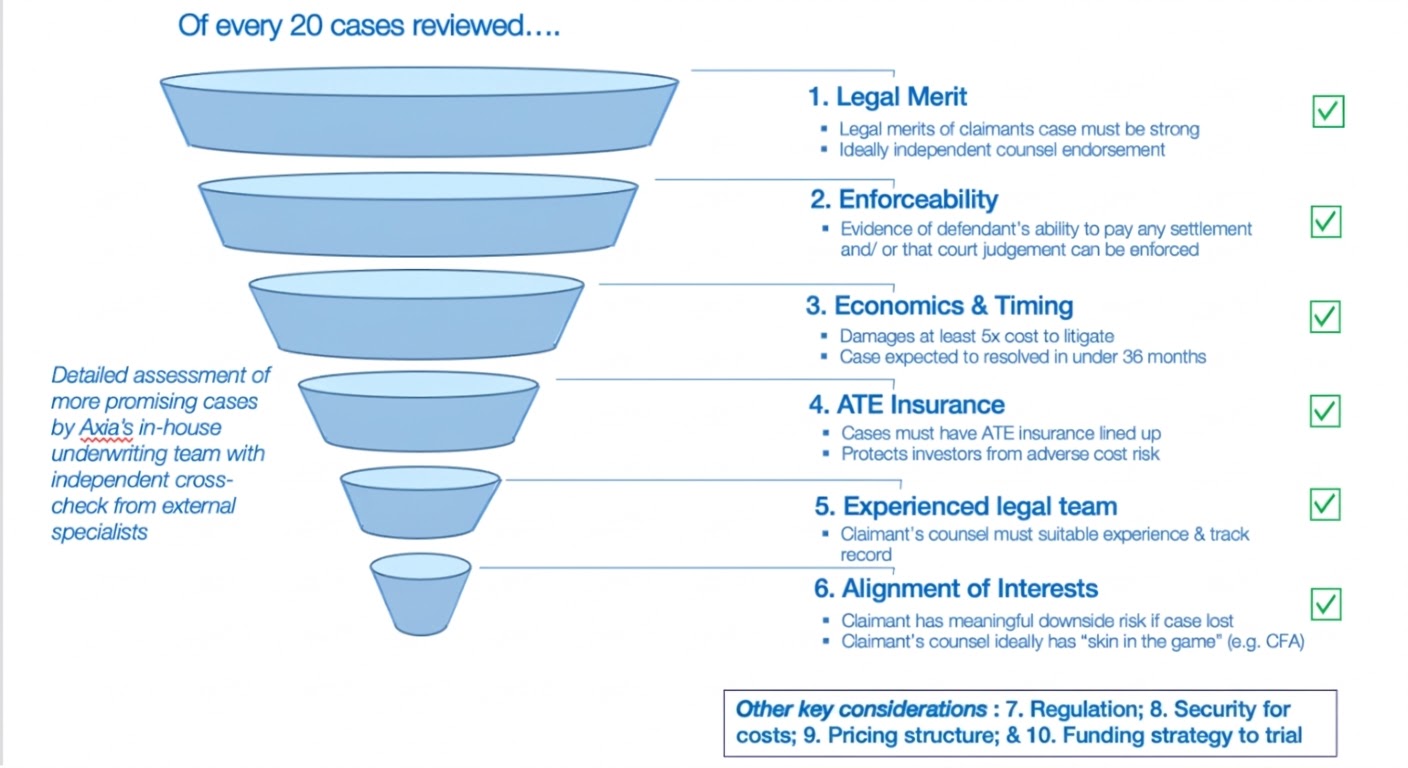
Each claim is evaluated against ten key criteria, covering its legal merits, enforceability, economics, risks and other relevant factors, as illustrated in Figure 1 below. (Learn how our underwriters evaluate liability and independent counsel opinions in our overview of Case assessment: Legal merits.)
Figure 1: Case Assessment Framework
7.3.3. Monitoring
Throughout the life of a funded claim, AxiaFunder closely monitors its progress and maintains regular communication with the claimant and instructed law firm to discuss claim developments, potential risks and any emerging issues.The instructed law firm is required to provide quarterly claim updates, as well as additional updates whenever material developments occur. Based on this information, AxiaFunder prepares quarterly investor updates summarising the claim’s progress, key developments and any changes to its risk profile. Investors are notified by email when an update is published.
7.3.4. Resolution
Upon resolution of the case, the investment is wound up and the available principal and contractual returns are distributed to investors, depending on the outcome of the case and the proceeds recovered.Unlike portfolio offers, where distributions are made progressively, investors in single commercial case offers typically receive a single distribution following the resolution of the claim, with the investment generally wound up through the redemption of their Partnership interests, where applicable.
Investors receive a detailed resolution update and are notified of the distribution by email.
7.4. Investment Structure
Investments offered through the AxiaFunder platform are structured as interests in Scottish Limited Partnerships (SLPs), which may offer certain tax advantages to investors. An SLP is a form of limited partnership established under Scots law. Unlike limited partnerships established elsewhere in the UK, SLPs have separate legal personality, allowing them to hold assets and enter into contracts in their own name.Unlike a UK limited company, an SLP is generally tax transparent, meaning that profits and gains are taxed at the level of the individual partners rather than the partnership itself. Investors are therefore generally taxed on their share of the underlying investment's profits or gains.
Based on our tax analysis, returns from investments in litigation cases are considered likely, although not certain, to qualify for capital gains tax (CGT) treatment for UK tax-resident individual investors, potentially offering a more favourable tax outcome than income tax treatment.
7.5. Secondary Market[3]
To improve investment liquidity and provide investors with an opportunity to exit before resolution, AxiaFunder has worked with its technology partner, ShareIn, to develop an automated secondary market.The secondary market can allow investors to offer their existing investments for sale to other investors, providing greater flexibility and potentially improving the attractiveness of litigation funding as an asset class. However, the ability to sell an investment depends on buyer demand and is not guaranteed. If the uncertainty regarding the prospects of a claim/claims funded by an offer, increase and make it too difficult to determine the value of the investment, AxiaFunder will close the secondary market for the claim until the outlook for the investment is clearer. AxiaFunder charges a fee to both the buyer and seller for any transactions via the secondary market.
For further information and to view historical trading activities, please visit the Secondary Market on our website.
8. CONCLUSION & CONTACT
Litigation funding represents an uncorrelated, asset-backed alternative for sophisticated and high-net-worth investors seeking portfolio diversification beyond traditional asset classes such as equities, bonds, and real estate.AxiaFunder provides qualified investors with direct access to thoroughly vetted single commercial cases and diversified portfolio investments, supported by transparent reporting and structured risk mitigation.
To view current opportunities or discuss how litigation finance fits within your portfolio, you can enquire with our team at [email protected], or visit our FAQs page for practical answers on account setup, investing and secondary trading.
[1] Although if a claimant terminates the contract with the law firm, they are typically required to pay the law firm for the work done to date. The law firm can use this cash to repay the funder.
[2] Please note paragraphs 7.2.3 and 7.2.4 relate to Housing Disrepair Claim portfolios, the monitoring and resolution of other portfolio case types can vary.
[2] Please note paragraphs 7.2.3 and 7.2.4 relate to Housing Disrepair Claim portfolios, the monitoring and resolution of other portfolio case types can vary.
[3] Technically from a regulatory perspective, the secondary market is a Bulletin Board as defined by the FCA.
Related Articles
- Investor Guide to Litigation Funding
- The Investor Appropriateness Test
- Risks for investors in litigation funding
- Understanding Your AxiaFunder Investment Portfolio
- AxiaFunder Portfolio Investment Returns
- AxiaFunder Featured in Legal Futures
- Highly Commended Innovative Lenders Award
- New Podcast on the Legal Funding Journal
- 4th Way Review on Dieselgate Portfolio Investment
- AxiaFunder - actions taken to protect investors
- AxiaFunder Wins Innovative Lender of The Year Award
- AxiaFunder Housing Disrepair Investment Returns
- AxiaFunder FCA Direct Authorisation
- AxiaFunder won Innovative Lender of the Year Award
- Access to litigation investments
- The Peer2Peer Finance News Power 50 2022
- AxiaFunder Review by P2P Platforms
- AxiaFunder Review by 4thWay
- AxiaFunder interview with CEO Cormac Leech
- AxiaFunder Targets Double-Digit IRRs